
In this article, we look at the best fish scalers to help you quickly remove stubborn fish scales prior to cooking.
Helpful tip, if you’re ever stuck without a fish scaler, the best fish scale remover can be found in your kitchen…a spoon.
However, if you’re looking for a more robust fish descaler, check out these options.

8 Best Fish Scalers for 2023
- Amison Fish Scale Remover
- Amayia Electric Fish Scalers
- Yamasho Brass Fish Scaler
- Kwizing Fish Scaler
- Big Norm-Feets 88111 Magic Fish Scaler
- Comfecto Scale Remover
- GiniHome Stainless Steel Scale Remover
- FireKylin Fish Scaler
1. Amison Fish Scale Remover
The Amison is easy to use an easy-to-clean fish scaler that works beautifully to scale your fish. Measuring a mere 8 inches in length makes it a good scaler; fish that have tough to soft scales will be excellent fish to scale.
It features sharp and robust teeth that can easily slice through them without damaging underneath skin and flesh. Its small size fits in your bag or a pocket, so you can effortlessly take it camping with you if you want to catch and cook your fish in the great outdoors.
2. Amayia Electric Fish Scalers
The Amayia Fish Scaler is an automatic fish scaler that can slice over fish skin to effortlessly and quickly remove the scales on top. The stainless steel roller blade is razor-sharp, and since a motor powers it, you don’t have to tire yourself out by scaling manually.
This electric fish scaler comes with a rechargeable battery and starts with just the touch of a button. The 2000mAh lithium-ion battery of this good fish scaler allows users to scale over 100 fish on a single charge!
The handle’s ergonomic design is so you won’t tire yourself out. The easy-to-use automatic fish scaler is typically used in fish markets by fishmongers, but it can also come in pretty handy on a long fishing trip.
3. Yamasho Brass Fish Scaler
Scaling dozens of big fish one after another can take a toll on you, but not when you have a fish scaler designed to prevent fatigue. Considered to be one of the finest handheld fish scalers in the market, the Yamasho Brass Fish Scaler stands out and is different from your average fish scaler thanks to its ergonomic design.
Fish scaling doesn’t get any easier than this. The deceptively simple scaler for fish requires little to no effort in completely removing scales. It has a single wooden handle alongside a brass head and boasts a functional design.
The stainless steel blade is quite sharp, so the chances of injuries are small unless you don’t have practice using a fish scaler. You can preserve that edge for a long time by washing the scaler well after every use and air-dry afterward.
4. Kwizing Fish Scaler
Nothing is more annoying than trying to scale a big fish with a fillet knife. While it’s not difficult for seasoned professionals, it’s different for novices who may injure themselves or ruin the fish in using it. The Kwizing Fish Scaler accommodates both.
The Japanese fish scaler has the most extensive coverage that you can find. It has over 32 serrated sawteeth, ensuring complete and effortless scale removal from the toughest of fish. This includes removal from areas that are hard to reach, such as under the belly and the fins.
The non-slip and ergonomic handle lies comfortably in the hands, and the three grooves catch loose scales without allowing them to splatter all over your clean clothes. You can also get a Kwizing fish scaler brush to go with your fish scaler.
5. Big Norm-Feets 88111 Magic Fish Scaler
The Big Norm-Feet Magic Fish Scaler is explicitly designed to allow novice and seasoned anglers to scale their own catch without being messy and wasting time. Remove each scale effortlessly, and catch loose scales from fish skin without getting dirty or ruining the meat.
It features a flat handle that is easy to grip and offers a wide grip so the fish scaler will not slip from your fingers. The simple and efficient design specifically prevents injuries, making this easy-to-use fish scaler a must-buy.
The ‘free-floating’ fingers can quickly remove tough scales without splattering them everywhere. So while it may look simple, this is one of the best fish scalers you can get for your camping and fishing trip for several fish types.
6. Comfecto Scale Remover
The Comfecto Fish Scaler, designed with 30 individual stainless steel sawteeth, is one of the best fish scalers on the market. The scaler is serrated to ensure effortless scale removal, even for small fish.
Use it to remove scales without tearing the skin and without making them fly in all directions as you work. The ergonomically designed handle provides a grip that will always be comfortable and firm as you scale each fish.
It is relatively easy on the hands, wrists, and arms so that you won’t tire out quickly. Plus, it also features a hook ring to hang on your kitchen wall. It also holds well in saltwater so that it won’t erode quickly even after years of use.
7. GiniHome Stainless Steel Scale Remover
The GiniHome Stainless Steel Fish Scaler is a gorgeous silver-colored scaler that can be kept pristine once washed. With effortless performance, it is perfect for scaling all types of fish.
It’s about 7 inches long, making it handy on long fishing trips and useful at home to scale freshly caught fish before cooking it.
As one of the best fish scalers for home chefs and anglers who love to cook their catch, the GiniHome should be on your list when you are shopping for stainless steel fish scaler.
8. FireKylin Fish Scaler
The FireKylin is one of the best fish scalers in the market and a few others. This 2-piece scaler is made of stainless steel and can remove scales easily and quickly.
The scalers, which are fish scrapers, have a sawtooth head. A couple of strokes should be enough to get a clean fish.
The fish scaler also has a hook hole at the end so you can hang it in your kitchen to keep it within easy reach. The high-quality material will not rust with use, provided it is appropriately maintained.
It is small-sized enough to fit in your hands and gentle enough to prevent the fish’s skin from getting damaged.
Best Fish Scalers Buyer’s Guide
The fish scalers mentioned above are some of the best fish scalers you can get in stores or websites (such as amazon com) for large and small fish.
However, if you want to shop for a scaler yourself, look out for these things to ensure a best buy:
Durability
A good fish scaler is sturdy enough to withstand prolonged use without breaking and rusting. Look for scalers that are made from high-quality stainless steel. These do not break or bend easily and will not oxidize, no matter how many times it comes into contact with water.
Ease of Use
Some scales can be challenging to remove, and you can lose precious meat by using low-quality scalers. Just because you are fond of it doesn’t mean you should stick with it if it ruins the fish.
It should be able to remove every scale without getting stuck and contains the scales in one area. That way, you can spend more time filleting and cooking rather than cleaning up. A good fish scaler should also allow you to get into challenging areas, such as under the fin and the belly.
One way to minimize the mess of scales popping is to use the scaler while holding the fish underwater.
Electric vs. Manual
There are many useful manual fish scalers out there, but even the best ones can prove useless if you don’t have a steady hand. The best electric fish scaler can help you remove scales in record time and without causing fatigue.
Depending on where you are scaling fish, you can get one without a cord or one that comes with a cord. The latter is not portable, so you cannot take it on a boat with you. However, a portable one is ideal if you need to scale your fish in the water.
Comfortable and appropriate
Using a scaler you’re accustomed to or familiar with is essential, but keep in mind that using the appropriate quality scaler tool will help you get the job done correctly and efficiently.
Using a Spoon
If you don’t have a good fish scaler handy, you can always use a spoon. Just hold the fish’s head in one hand and apply short raking motions up and down the body using a steel spoon. Do this on each side of the fish, including the fins and gills.
How to Descale a Fish
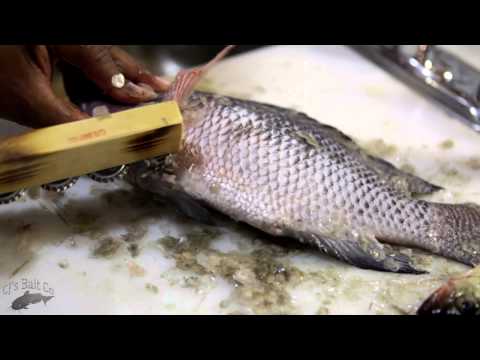
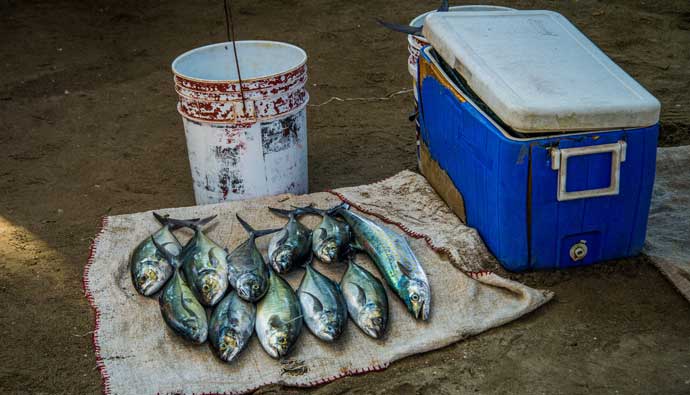
When you catch your fish, please place it in a cooler filled with ice water immediately to keep the flesh firm and the flavor intact.
When you come back to shore or on the boat, find a spot where you can scale your fish and clean up easily. Grab your fish scaler and start scaling by holding the fish in one hand and using the same method mentioned in the ‘Using a Spoon’ section.
Frequently Asked Questions
A fish scaler is exactly what it means. It is a unique tool used to remove each scale from a fish before cutting it up. The finest ones are those that you can use quickly and can last for years of prolonged use.
An electric fish scaler can effortlessly remove fish scales since a motor powers it and requires less labor. This reduces human error so that you won’t lose precious meat.
To prepare fish for cooking, you have to understand who you’re cooking for. If you like to eat crispy fish skin, you should ensure the fish fillet still have some scales on them. If the taste of flaky scales is repulsive to you, feel free to remove them with a scaler. However, some fish have to be scaled before they are filleted and cooked.
These fish species have an outer fish slime coat that can be quite unpleasant to eat. Remove the scales only when you are about to cook them to keep the meat nice and fresh.
The four main types of scale are ganoid, cycloid, ctenoid, and placoid.
Insider Advice
Whether you like to eat fish with scales or not, having a fish scaler in your kitchen and camping gear prepares you for instances when you need it. Maybe your family or guests don’t like scaly fish.
You can have a manual scaler at home and take an electric one on camping trips where you’ll have lots to do.
The reviews mentioned above will significantly help you make an informed decision, so you can end up with the right fish scaler that will fit your personality and preference and one that you will like.
 Founder & Angler


 Facebook
 YouTube