
We surveyed 850 people on what the best underwater fishing camera was. A resounding 83% answered GoPro, followed by 11% saying their iPhone. A mirrorless camera and housing came in at 4%, and the Insta360 came in last at 2%.

6 Best Underwater Fishing Cameras for 2023 Reviewed
- Best Underwater Fishing Camera – GoPro Hero 11
- Best HDR Underwater Fishing Camera – Insta360 ONE R 360 Edition
- Best Cheap Underwater Fishing Camera – Campark ACT74 Action Camera
- Best Bobber Camera – Anysun Underwater Fish Camera
- Best Underwater Camera for Ice Fishing – Marcum Camera
- Best Bait Video Camera – GoFish Underwater Camera
1. GoPro Hero 11
The Best Underwater Fishing Camera
A GoPro is essential for any spearo who’d like to showcase their shooting skills with their friends back home. Most people don’t know what it takes to dive down the underwater world and land a prized fish while holding your breath.
With a GoPro, you’ll never miss showing off that stoned fish.
GoPro Hero 11 offers superior image camera quality. In the poorest conditions, the GoPro Hero 6 proves to produce a higher quality image than its predecessors.
The GoPro Hero 11 works exceptionally well with natural light and equally as well, even without a filter, but when you need the added light, the GoPro offers at least 1200 lumen light to get the perfect color with a filter. It deserves to be one of the best underwater cameras today.

2. Insta360 ONE R 360 Edition
Best HDR Underwater Fishing Camera
The Insta360 One R 360 Edition is the jack of all trades in this lineup. It is perfect for those at the start of their underwater fishing video content journey. If you want sharp and crisp videos and photos, the camera is HDR, so your media will turn out perfect.
You can convert this clever modular camera into a 4K action camera, a 1-inch sensor camera, or a 360 drone. Besides, its stabilization allows smooth and seamless videos from bumpy boat rides and rocky trails to on-the-go dashcam footage with ease!
This camera lives up to its main promise because it’s very convertible. You can take photos or videos in and out of the water. It has many features like image stabilization and wi-fi connections. Unlike other underwater fishing cameras, this camera has instant playback to see if you got the perfect shot.
It also has smart templates, or the “Shot Lab,” where a selection of effects is readily available. On top of that, you can adjust the colors in your underwater fishing photos and videos via its Color Plus.
What’s more, the Insta360 ONE R 360 Edition lets you switch between a full spherical camera, 4K action cam, 1-inch sensor camera, and more. It’s one of the most versatile all-in-one solutions for every underwater fishing production yet.

3. Campark ACT74 Action Camera
Best Cheap Underwater Camera
The Campark ACT74 Action Camera is more of a price-friendly camera running between $50.00-$60.00. This camera is affordable on almost any budget.
The Campark ACT74 Action Camera offers many great features, including;
- Super 4k Recording.
- 2 inch HD screen + 170-degree wide-angle lens.
- Wifi Remote.
- Waterproof up to 30m (98 feet).
- Dual recharger batteries + mounting accessory kit.
The Campark ACT74 Action Camera offers a 4k resolution that is comparable to the GoPro Hero 5, with photo resolution being 16mp via the 170-degree wide-angle lens.
- Waterproof capabilities; The Campark ACT74 Action Camera comes with a waterproof case that allows it to go down to 100 feet, while it can dive up to an impressive 33 feet without the case.
- Storage capability; The Campark74 Action Camera is lacking in this department with up to 64GB which is considerably less than the HERO series, which stores up to 128GB.
- Voice Control: While the HERO series 5 & 6 underwater cameras offer HDMI and wifi, the Campark74 Action Camera offers these features as well, and additionally Bluetooth.
- Display: The Capark74 Action Camera offers a 2-inch color display screen that is not a touch screen, whereas the HERO series 5 & 6 do offer the touchscreen feature.
- Included accessories: When you purchase a Campark74 Action Camera, you can expect it to include a waterproof case, two rechargeable batteries, a charging cable, and a variety of clip mounts and brackets that will fit almost any situation.

4. Anysun Underwater Fishing Camera
Best Bobber Camera
This is one of the more advanced bobber fishing cameras. You’re sure not to miss a single shot. The Anysun features include;
- MONITOR: 7-inch TFT color monitor with sun visor for bright environments.
- FEATURES: Sony CCD 800TVL HD Video Camera with 360 Degree View and an OSD Menu Remote Control Fish Finder Camera. There are 16 high-power white LED lights for the camera.
- BATTERY LIFE: Battery life lasts up to 10 hours when continuously used. The light indicator will show red while charging, and when the battery is full, it will show green.
- CABLES: The cables are weather-resistant, waterproof, and pull-resistant cables. The available camera extension cable length is 20 meters.
- USAGE: Ideal underwater fishing cameras for monitoring aquaculture, underwater exploration, ocean/lake/ice fishing, underwater salvage, and so much more.

5. Marcum Underwater Camera
Best Ice Fishing Camera
When it comes to the best underwater fishing cameras, there are several factors to consider when deciding on the right camera to fit your need. In the case of ice fishing, the elements are a factor not to be overlooked. Marcum Underwater Camera ticks all the boxes!
Here’s what it’s like to use the Marcum VS485c as an ice fishing camera:

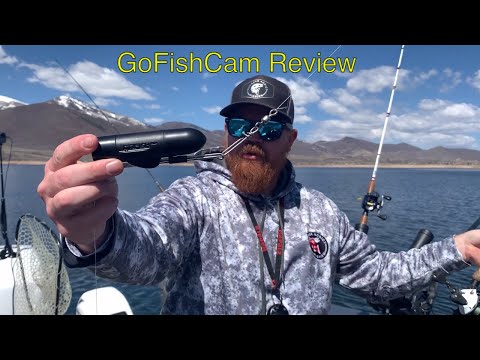
6. GoFish Underwater Camera
Best Bait Camera
A bait camera will get you just about as close to the action as you can get when fishing in the underwater world. Not only does it give you the advantage of seeing the fish at the moment it takes the bit, but it also allows you to see and study how various baits are performing underwater.
Before the advent of underwater cameras, an angler could only guess how well their baits were performing. Now, with underwater technology, anglers study not only baits but also fish behavior.
The GoFish Underwater Camera offers the following features;
- Sony Super HAD CCD, .05 lux camera with 60′ of cable and stabilizer fin.
- 7″ high screen resolution, rubber-coated black & white CRT monitor.
- Darkwater LED lighting technology greatly reduces particle reflection for a brighter and clearer view.
- 12V, 7Ah rechargeable battery, and 3-stage auto battery charger.
- Soft padded carry/storage pack with a built-in sun shield.

Why Do You Need an Underwater Fishing Camera?
The benefits of an underwater fishing camera are numerous. Some of the important reasons are “sizing up the competition” and allowing the angler to pick the more “hot spots” for bigger fish.
An underwater camera allows you to see and study fish behavior, and it allows you to see firsthand from a fish’s perspective. This allows you to see how baits and lures respond in various water conditions and how fish respond to them.
How To Care For Your Underwater Camera

- MAINTENANCE for your housing starts before you go diving. At the start of a fishing trip, remove the sealing O-ring from its groove, and apply a small amount of the supplied O-ring grease.
- IT’S IMPORTANT TO CHECK the O-ring for any debris that might interfere with creating a seal. Do this while applying a light coating of grease to the O-ring and every time you open and close your housing.
- KEEP YOUR HOUSING OUT OF THE SUN to prevent camera fogging. The best sunscreen is a damp towel — if you’re out in the hot sun, place the towel over your housing. Always keep a couple of desiccants in the housing to help prevent it from fogging.
- NEVER LEAVE your housing unattended in the camera-only rinse bucket, as this is where quite a bit of flooding occurs. People often throw their underwater cameras in the bucket or mishandle your system to make room for theirs.
- AFTER YOUR DIVE IS OVER, rinse your housing in fresh water to flush away all the salt water. Dip your housing in fresh water, and depress the control buttons to make sure all the salt is removed from the crevices.
- ALL HOUSINGS REQUIRE some long-term maintenance. Follow the manufacturer’s recommendations for routine maintenance, such as replacing the O-rings and sending in the housing for a checkup. This should help you avoid costly repairs.
Repairs To Your Underwater Camera
For minor scratches, we recommend using Smitty’s Glass Wax.
- One (1) Micro-fiber cleaning cloth and One (1) 1oz Bottle of Smitty’s GlassWax
- Perfect for both Prescription Glasses & Sunglasses
- 100% Safe & effective on all types of glasses
- Special wax that repels dirt & keeps glasses clean for weeks
Waterproof Housings

Waterproof housings are by far one of the most important items that require regular visual maintenance. This includes checking for leaks, foreign debris that can get trapped in between seals, and worn and dried seals that may need to be replaced.
Underwater Fishing Camera Buyer’s Guide
The following is a list of things to think about when shopping for an underwater fishing camera:
- What are you using it for, and what types of conditions do you expect to encounter?
- What features do you need your camera to have – sun visor, night vision, HD camera, wireless connectivity, infrared lights, or camera housing?
- How is the camera quality?
- What screen resolution will suffice your needs?
- Memory size – How long do you plan to shoot each day?
- Size of the camera
- How long are you planning on using it? What’s the battery life like?
- Are you planning on going night fishing?
- How deep do you expect to take it?
- What types of water conditions does it need to handle? (For example, will you primarily be doing tropical fishing, or will you also be ice fishing?)
- What’s your price range?
- How do you plan to edit it?
- What’s the video quality like?
There is no doubt that underwater cameras have brought anglers literally face-to-face with the fish in their fishing adventures. They have also allowed the sport of fishing to evolve in ways that could not have been imagined 50 years ago.
If you don’t already own an underwater fishing camera, it is something you may want to consider. There is a certainty t it will bring the sport of fishing into a whole new light.
 Founder & Angler


 Facebook
 YouTube