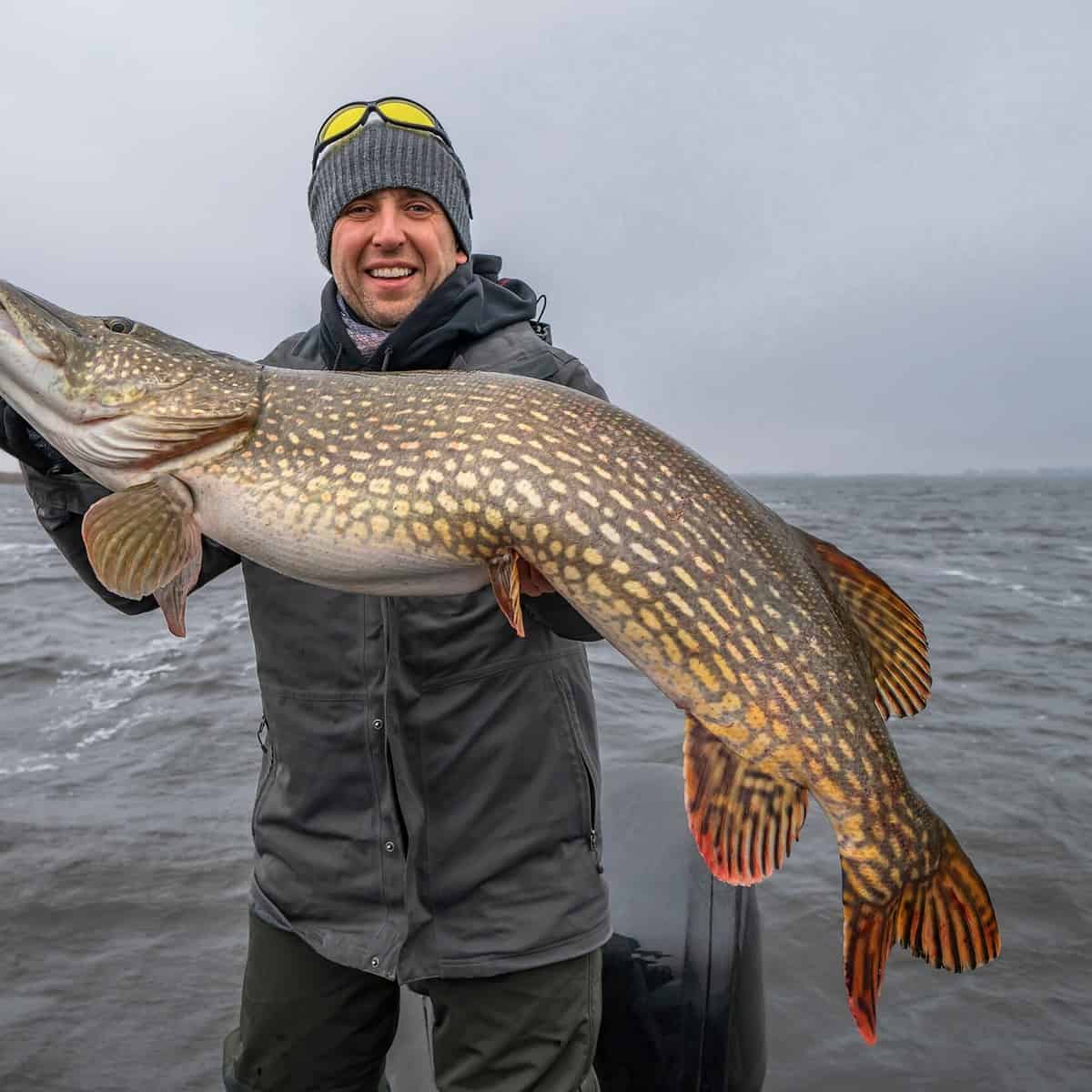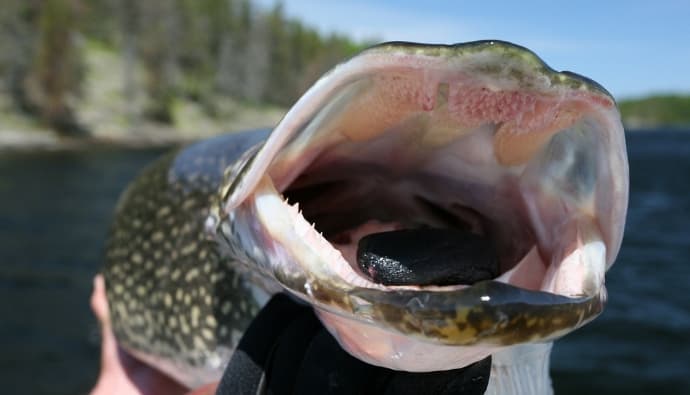

Northern Pike are some of the most exciting freshwater game fish to go after!
They have long slender bodies and toothy powerful mouths! Make sure you don’t get your fingers mangled by pike teeth when you’re removing a hook.

You might just leave the fishing day with one less digit…
These fish can be found in most bodies of water in the northern United States and fight a lot harder than largemouth bass!
In this article, I am going to cover all things northern pike fishing. This includes understanding the best pike fishing lures, pike fishing tips, where to find them, and even how to eat them.
Let’s go learn how to catch pike!
Northern Pike Facts
| Common Names | Great northern pike, lake pikes, snot rocket, slimer, slough snake, northern gator, and slough shark. |
| Scientific Name (Genus and Species) | Esox lucius |
| Family | Esocidae |
| Identifying Characteristics | The spots on the Northern Pike will be lighter than other species of pike which will be darker. Their cheeks are fully scaled and the bottom half of the gill cover is not scaled. Look at their underjaw pores, if there are around five, it’s a good chance it’s a Northern Pike. |
| Habitat | Look for them in the weedy parts of ponds, rivers, and lakes |
| Depth Range | They are found in the entire water column of most rivers and lakes. |
| Fishing Information | Pike enjoy primarily other fish but will eat birds like ducks and shorebirds, muskrats, mice, frogs, and whatever else floats their way. |
| Size | There have been some recorded up to 41 pounds in Europe, however, that size is uncommon in the US. |
| Largest Recorded | The Cedar Lake catch is famous as the 67 pounds 4 ounce Northern Pike caught by Arno Wilhelm in 1983 in Germany. |
| Mercury Risk | According to the Alaska Department of Health and Social Services, the mercury risk of pike is low. |
| Endangered Status | Least Concerned. Unfortunately, in some areas, they are considered invasive. |
More Northern Pike Trivia
- These fish are some of the oldest species of fish that are thought to have existed over 65 million years ago!
- The females being bigger and heavier than the males.
- Each female can spawn up to 200,000 eggs in the spring which give the little fry plenty of time to grow before winter!
- Since they are some of the largest freshwater fish as well as how aggressive they are they do not have many predators in the wild, other than humans.
- The smaller fish and younger pike are preyed on by larger birds of prey. Foxes, as well as other pike and larger predatory fish.
- Overfishing by humans and chemical pollution are the biggest threats faced by pike.

Seasons for Pike Fishing (And Where to Fish for Pike)
When looking for good areas to search and fish for pike, remember:
Spring
Pike often are going to be shallow looking for places to spawn and or spawning. They can almost always be found in areas with high vegetation so that they can stay camouflaged. Follow the trail they leave to deeper water. You’ll also find them over weed beds in the late spring.
Summer
They can be found deep in the middle of the lakes and rivers where the baitfish are being rounded up deep by the predatory fish.
Fall
They are in the shallows again looking for prey to feed on. Most of the time very well hidden in reeds and grass mats to keep the prey fish from seeing them before they strike. When the fish are hiding in the shallows they will pretty much strike at anything whether they follow it up, or simply react to seeing the bait and engulf it out of instinct.
Winter
They are looking for quick easy meals and can be found deep in the middle of lakes and rivers searching for anything easy to eat. Like most fish, in the winter their metabolism slows down as does the fish which causes them to move slower and go after easier targets.

How To Catch Pike (And Pike Fishing Gear)
Fishing for pike is similar in a lot of ways to fishing for bass and other predatory fish, the only difference with pike is their size.
Best Rod for Pike
To start off with a good 7-foot medium-heavy rod is the best choice due to the relative size of the fish you are going for.
Yes, you will catch smaller pike but when a tank hits your line I assure you, you will want a bigger rod.
Best Line for Pike
The next thing you need to be looking for is your line, 20-50 lb braided line with a steel leader is suggested.
This is due to the number of sharp teeth in a pikes mouth, which can cut your line if there is not a leader in place.
Best Reel for Pike
When choosing a reel, a 2500 reel and bigger will suffice.
Best Lures For Northern Pike
The best lures for The Northern Pike can vary from the body of water, but one thing stays a constant, baits with blades and spinners work year around, all you have to do is change your retrieve.
Inline Spinners
Inline spinners are great baits for any type of predatory fish as they generally catch anything that goes after bait fish.
Always remember when using an inline spinner to use a swivel attached to your leader. The blade on the bait will almost always cause the lure to spin and can tangle and twist up your line over time.
Spoons
Spoons, just like soft plastic, are another great lure to use for Northern Pike as they mimic baitfish like no other lure.
Yet again like the inline spinners, always remember to use a swivel on your leader as they tend to spin in the water and generally always will twist up your line and cause wind knots if you are using spinning gear.

Topwater Lures
A topwater fishing lure is another great way to catch Northern Pike as they will typically feed on anything that moves in the water.
Frogs
Topwater frogs work wonders as you can cast them onto the bank and twitch or wake them back to you.
Mammals
Topwater rats or mice are another great bait to use for Northern Pike. They feed on any mouse or rat that tends to fall into the water or decides to swim across to the other side. (Which happens more than you would think!)
Ducks
Topwater ducks and bats work well on a pike as the size of the lures tend to keep Largemouth or Smallmouth Bass at bay.
Many times in areas where there is large pike you will see ducks or geese swimming in the water and all of a sudden a pike blows up on one of the baby birds.
Soft Plastic
As far as soft plastic goes, you can essentially use any of the best soft plastic baits for bass you would normally use for Largemouth Bass or Smallmouth bass.
Wacky rigged Senkos or stick baits work wonders for smaller pike, as well as smaller swimbaits and creature baits that are texas rigged.
Another method for catching pike is to throw an Alabama or umbrella rig.
This gives the presentation of a small school of baitfish just waiting to get eaten by the nearest predator!

How to Cook Northern Pike (Best Recipes)
Northern pike may not be on the list of the best tasting freshwater fish to eat but it can be with these recipes.
1. Oven Baked Northern Pike
Courtesy of Primally Wild
- 1-2 lb Pike fillets cut into 2″ wide strips
- Salt and Pepper to taste
- 1 tsp garlic powder
- 1 tsp dried thyme
- 1 tsp dried rosemary
- ~2-3 Tbsp butter
- 1 lemon sliced
Directions
- Preheat oven to 350
- Lay the strips on a baking dish.
- Dust lightly with all of the spices. Be careful not to overdo it here, you don’t want these tasting like a mouth full of spices.
- Place slices of butter topped with a slice of lemon randomly on the strips of fish.
- Bake for about 15 minutes.
2. Beer-Battered Northern Pike
Courtesy of In-Fisherman
- 1 ½ pounds firm fillets
- ¾ cup flour
- 1 teaspoon each salt and pepper
- Dash of cayenne pepper
- Batter Ingredients:
- ¼ teaspoon baking soda
- 1 cup milk
- 1 egg
- 2 tablespoons beer
- 6 cups oil for frying
- 2 tablespoons dark sesame oil (optional)
Directions
- Rinse the fillets, pat them dry, and cut them into a finger shape, about 3 inches long and 1 inch wide.
- Keep them cold until ready to fry.
- Whisk together all the ingredients for the batter until smooth. Allow the batter to rest for about 15 minutes.
- Combine the flour with the salt, pepper, and cayenne. Lightly dust a fish finger in flour, immediately submerge it in the batter, shake off the excess, and lower it into the hot oil.
- Fry each batch 3 or 4 minutes until golden brown.
- Remove to a plate and let drain on paper towels.
- Serve this classic dish with tartar sauce along with fat wedges of lemon, or with malt vinegar.
Final Thoughts on Northern Pike
When it comes to fishing for the trophy of a lifetime, there is no better fish than the Northern Pike.
Pike can grow big, quick, and can be some of the best fighting fish on the planet!
Just remember to always go out with a pair of gloves and fishing needle-nose pliers! These fish’s sharp teeth are nothing to play with!
If you live in an area where northern pike is, go out and give them a shot! These fish are always feeding and can be a great fish to go after!
Frequently Asked Questions
Q: Do pike bite?
A: Yes! They have rows of sharp teeth on top and bottom as well as strong jaws.
Q: Are pike hard to catch?
A: Not particularly. Being an opportunistic feeder, pike will usually hit anything they see as potential prey.
Q: Where are pike most commonly found?
A: Northern United States and Canada in almost all of the river systems.
Q: When do pike spawn?
A: In the spring.
Q: How big to pike get?
A: They can range in size from 21 inches to 71 inches and weigh up to 60 pounds!
 Founder & Angler


 Facebook
 YouTube